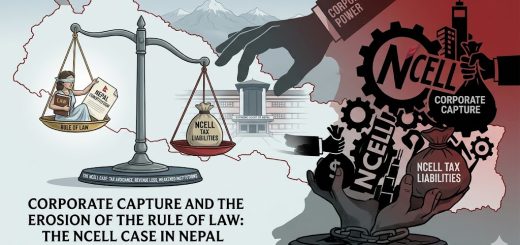
Corporate Capture and the Erosion of the Rule of Law: The Ncell Case in Nepal
A Critical Analysis for Law Students
“When Ncell was sold for the twelfth time, the country’s legislature, government and judiciary were drawn into the tax evasion scandal linked with the telecom company. The controversy escalated after authorities exempted the company from paying capital gains tax. All three organs of the state — the government, the parliament and the judiciary (some openly while others secretly) — favoured tax exemption for Ncell.” — Centre for Investigative Journalism, Nepal (CIJ-Nepal)
Abstract
Table Of Contents
- 1 Abstract
- 2 1. Introduction: What Is Corporate Capture?
- 3 2. The Corporate Structure: Opacity as a Strategy
- 4 3. Political Pressure at the Highest Levels
- 5 4. Judicial Influence: The Three-Act Tax Drama
- 6 5. The Tax Settlement Commission: Another Avenue of Avoidance
- 7 6. The Smart Telecom Scandal: Regulatory Paralysis as Corporate Gift
- 8 7. The ICSID Gambit: International Law as Pressure
- 9 8. Theoretical Framework: Understanding Corporate Capture
- 10 9. What the Law Demands — and Where It Has Failed
- 11 10. Comparative Perspective: Why This Matters Beyond Nepal
- 12 11. Recommendations for Law Reform
- 13 12. Conclusion: The Rule of Law as a Corporate Battleground
- 14 Key References and Sources
This article examines the sustained pattern of alleged corporate influence exercised by Ncell Axiata Limited — Nepal’s largest private telecom operator — over the institutions of the Nepali state across more than a decade. Drawing on investigative journalism, Supreme Court records, parliamentary committee findings, and international arbitration proceedings, this article identifies a consistent pattern of what scholars of governance call “corporate capture”: the process by which private interests systematically bend regulatory, judicial, and legislative institutions to protect corporate profits at public expense. The Ncell case is not merely a tax dispute. It is a textbook study in how offshore corporate structures, political networking, judicial influence, regulatory paralysis, and international legal pressure combine to insulate a corporation from its legal obligations. Law students, future advocates, judges, and policymakers must understand this pattern to protect constitutional governance from it.
1. Introduction: What Is Corporate Capture?
Corporate capture — sometimes called regulatory capture or state capture — refers to the process through which private economic interests gain influence over public institutions to the degree that those institutions serve the private interest rather than the public good. It operates not through a single act of corruption but through the accumulation of smaller advantages: a favourable interpretation here, a delayed investigation there, a strategically placed ally in office at the right time.
The Ncell case in Nepal is an exceptionally well-documented example of this phenomenon, involving:
- A multinational telecom company with ownership routed through multiple tax-haven jurisdictions
- A decade-long campaign to avoid or reduce tax liability running into tens of billions of rupees
- Evidence of political lobbying at the highest levels of government
- Judicial decisions that progressively reduced the company’s obligations
- Regulatory inaction that allowed state assets to be diverted to corporate use
- The use of international arbitration as a pressure weapon against a developing-country government
- And most recently, the appointment of a Chief Justice whose past judicial record directly favoured the same company
Each element on its own might be explainable. Together, they describe a system.
2. The Corporate Structure: Opacity as a Strategy
To understand the Ncell controversy, one must first understand how the company is structured — because the structure itself is an instrument of legal avoidance.
Ncell began as Spice Nepal Private Limited in 2001 and was subsequently sold fourteen times between fiscal years 2060/61 BS and 2079/80 BS, according to a government-commissioned investigation committee report obtained by Khabarhub. Each change of ownership passed through holding companies in tax haven jurisdictions — Saint Kitts and Nevis, the British Virgin Islands (BVI), Cyprus, and the Seychelles — that were registered by intermediary law firms specialising in offshore corporate structures, including the now-defunct Mossack Fonseca, whose leaked files became the centre of the global Panama Papers scandal.
When TeliaSonera (Sweden/Finland) sold its 80% stake to Axiata (Malaysia) in 2016, it did not sell Ncell directly. It sold Reynolds Holdings Limited, a shell company registered in Saint Kitts and Nevis, which held the majority stake in Ncell. The deal — worth approximately $1.4 billion — was consummated abroad. This structural device allowed the sellers to argue that no taxable transaction had occurred on Nepali soil.
The Centre for Investigative Journalism Nepal (CIJ-Nepal), working with the International Consortium of Investigative Journalists (ICIJ) and documents from the Panama Papers, uncovered the following additional layer: several Nepali businessmen — including individuals with documented links to political parties — had invested in Ncell through offshore companies registered in tax haven countries, then repatriated money to Nepal as “foreign direct investment” (FDI). CIJ-Nepal found that Ajeya Raj Sumargi, a businessman with close ties to the Maoist movement, transferred a total of $48,372,222 (over Rs 480 million) into Nepal in 23 instalments without obtaining required FDI approval. Former lawmaker Birendra Mahato and his brother Upendra Mahato, the founding president of the Non-Resident Nepali Association, were also named in investigations for their investments in Ncell-linked offshore structures.
This web of ownership — combining foreign telecom giants, UK special purpose vehicles, BVI holding companies, Seychelles-registered entities, and Nepali politically-connected investors — made it extraordinarily difficult for any single national regulator to follow the money. That difficulty was not incidental. It was the product of legal engineering.
Lesson for law students: The use of multi-jurisdictional corporate structures to obscure beneficial ownership and avoid tax is a globally recognised problem addressed by instruments including the OECD Base Erosion and Profit Shifting (BEPS) Framework and the FATF Recommendations. Nepal’s failure to sign Mutual Legal Assistance Treaties (MLATs) with key tax haven jurisdictions — and its domestic anti-money laundering agency’s demonstrated weakness against politically connected actors — created a legal vacuum that corporate actors exploited to its fullest extent.
3. Political Pressure at the Highest Levels
Nepal’s Office of the Auditor General, in its 54th Annual Report, was the first official body to assert that the TeliaSonera–Axiata transaction was taxable under Clause 57 of Nepal’s Income Tax Act 2058 and that the government was entitled to recover approximately Rs 32 billion in capital gains tax. This report, published in 2017, energised civil society and launched the legal campaign that ultimately reached the Supreme Court.
But crucially, the report also revealed that Ncell and its political allies had been working against this finding before it was published. A former acting Auditor General disclosed that “a government secretary and a joint-secretary had come to request not to show it as irregularities.” This was a direct attempt by state officials — acting at the behest of corporate interests — to suppress a public audit finding.
At the parliamentary level, the Inland Revenue Department Director General had, in January 2016, informed the Parliamentary Development Committee that Nepal had a bilateral double taxation avoidance treaty with Norway — which would imply no tax was due on the buyout. Legal experts have since confirmed that this interpretation was incorrect and that the treaty was selectively invoked. There was, in the words of CIJ-Nepal, “high political pressure to the parliamentary Finance Committee in order to facilitate the closing of the deal.”
Then-Prime Minister Pushpa Kamal Dahal ‘Prachanda’ presented a cabinet plan to tax TeliaSonera for its Ncell acquisition — but also to exempt Ncell from taxation. This plan met with opposition from three cabinet secretaries. TeliaSonera, for its part, sent a formal thank-you letter to then-Prime Minister KP Sharma Oli, acknowledging his government’s role during the deal’s closure. A thank-you letter from a corporation that avoided tens of billions in taxes is not corporate courtesy. It is a receipt.
4. Judicial Influence: The Three-Act Tax Drama
The Ncell tax case moved through Nepal’s judicial system in a pattern that, when viewed in full, raises serious questions about the integrity of the process.
Act One — The Supreme Court victory for the state (2019): After civil society advocates filed a public interest writ, an extended full bench of the Supreme Court headed by Chief Justice Cholendra Shumsher Rana ruled on February 6, 2019, that Ncell and its parent company Axiata were jointly liable to pay capital gains tax. The Large Taxpayers’ Office subsequently determined the total combined liability at Rs 62.63 billion, including interest and penalties. This was a landmark ruling — the Supreme Court had upheld the state’s right to tax an offshore transaction that changed effective ownership of a Nepali company.
Act Two — The liability is slashed (2019): Ncell did not comply with the April 2019 deadline. Instead, it filed a fresh writ at the Supreme Court on April 22, just one day before the payment deadline, challenging the tax amount. A new full bench — this time including Justice Manoj Kumar Sharma — then scrapped the additional 50% penalty imposed by the Large Taxpayers’ Office under Section 120(A) of the Income Tax Act, reducing Ncell’s outstanding liability by nearly Rs 18 billion. The Supreme Court reduced the total liability to Rs 21.10 billion — a dramatic reduction from the Rs 39.06 billion demanded by tax authorities. Critics argued that the bench’s rejection of the Section 120(A) penalty was a legally unjustified gift to the company.
Act Three — Ncell’s judge becomes Chief Justice (2026): In May 2026, the Constitutional Council chaired by Prime Minister Balendra Shah recommended Justice Manoj Kumar Sharma — the same judge who was part of the bench that slashed Ncell’s tax liability — as Nepal’s 33rd Chief Justice, bypassing three more senior justices including Acting Chief Justice Sapana Pradhan Malla. This was the first time in Nepal’s judicial history that a fourth-in-seniority judge was recommended for the top judicial position.
Acting Chief Justice Malla, publicly bypassed, delivered a pointed public address warning that “manipulating legal traditions and constitutional procedures for vested interests reflects authoritarian tendencies and weakens constitutional morality.” Opposition parties, including UML and Nepali Congress, condemned the appointment. Former justices questioned the process. Two members of the Constitutional Council itself — National Assembly Chair Narayan Prasad Dahal and NC parliamentary party leader Bishmaraj Angdembe — filed formal notes of dissent.
Lesson for law students: This sequence illustrates a danger that constitutional scholars call “judicial structuring” — the practice of shaping who sits on benches and who ascends to leadership in ways that benefit particular interests. Nepal’s constitutional appointment process, which leaves significant discretion with the Constitutional Council (effectively controlled by the Prime Minister’s allies), lacks sufficient checks against exactly this kind of manipulation. Article 129 of Nepal’s Constitution requires only three years of Supreme Court experience for eligibility as Chief Justice — it does not mandate seniority. That interpretive gap is precisely what was exploited.
5. The Tax Settlement Commission: Another Avenue of Avoidance
Alongside the capital gains tax saga ran a parallel controversy involving the Tax Settlement Commission — a body established in 2015 to resolve long-pending tax disputes. The Commission, chaired by Lumba Dhwaj Mahat, reviewed tax liabilities worth Rs 30.52 billion but settled them at just Rs 9.54 billion.
The Office of the Auditor General’s findings revealed that Ncell was among the companies that received discounts from the Commission. VAT records showed that nine companies received waivers exceeding Rs 100 million — Ncell was on that list. The three principal officials of the Commission — Mahat, Umesh Prasad Dhakal, and Chudamani Sharma — were convicted by the Special Court on corruption charges in June 2023 and sentenced to nine years imprisonment each. However, in July 2025, the Supreme Court annulled those convictions on procedural grounds and ordered a retrial — a decision that itself has attracted controversy.
Chudamani Sharma — one of the three officials convicted — is the same official who, when he was director of the Internal Revenue Office, failed to respond to Axiata’s query about whether it would owe capital gains tax before the 2016 Ncell acquisition. His silence at that critical moment allowed the deal to close without a definitive tax ruling, a silence that benefited Ncell enormously in the subsequent legal battles.
6. The Smart Telecom Scandal: Regulatory Paralysis as Corporate Gift
In April 2023, Nepal Telecommunications Authority (NTA) revoked Smart Telecom’s operating license after the company failed to renew it, having accumulated approximately Rs 30 billion in unpaid regulatory fees, royalties, and penalties to the state. Under the Asset Management Rules for Telecommunications Service Providers Whose Licenses are Not Active (2022), Smart Telecom’s infrastructure — its towers, network equipment, and systems — legally came under government control.
The government’s obligation was clear: it should have immediately called a global tender for Smart Telecom’s assets or license, with proceeds intended to offset the Rs 30 billion owed to the state. This process was announced in principle. It was never executed. For two full years — from April 2023 to mid-2025 — the government took no effective action. Nepal Investment Mega Bank (NIMB), which had extended substantial loans to Smart Telecom secured against its infrastructure, grew impatient.
In September 2025, NIMB published a 15-day auction notice for Smart Telecom’s collateral assets. Three companies submitted bids:
- Transgate Tech Pvt Ltd: Rs 442 million
- Professional Business Network Pvt Ltd: Rs 425 million
- Ncell Axiata Limited: Rs 4.6 billion
Ncell’s bid was ten times higher than the next highest offer. Ncell won the auction and acquired the towers, equipment, and network infrastructure of its only significant competitor — the infrastructure on which Smart Telecom had built a presence across 19 districts. With this acquisition, Nepal’s telecom market effectively became a duopoly between Nepal Telecom (state-owned) and Ncell.
The Central Investigation Bureau (CIB) of Nepal Police subsequently arrested NIMB’s CEO Jyoti Prakash Pandey, charging him with fraud and criminal breach of trust — specifically for “illegally auctioning Smart Telecom’s assets with the dishonest intention of depriving the government of its rightful claim.” Smart Telecom’s former chairman Sarvesh Joshi was also arrested.
Former Communications Minister Jagdish Kharel — who served during the relevant period and who had personally visited Ncell’s data centre pledging government support — came under intense public scrutiny. Critics noted that Kharel had unexpectedly traveled to Switzerland as the scandal intensified, in what political opponents characterised as a flight from accountability. No formal charges had been filed against Kharel as of May 2026, but investigations remained ongoing.
Lesson for law students: This episode illustrates how regulatory inaction can function as a form of corporate subsidy. When the government failed to act on its legally established claim over Smart Telecom’s assets for two years, it created the legal grey zone that the banking system moved into — and that Ncell exploited to acquire competitor infrastructure at a fraction of its strategic value to the state. The question of whether that inaction was deliberate, negligent, or corruptly motivated is precisely what investigators must now answer. The legal framework — the NTA Asset Management Rules, the Bank and Financial Institutions Act, the Secured Transactions Act — contained conflicting provisions, and no inter-agency review mechanism was in place to resolve them. That gap did not arise by accident.
7. The ICSID Gambit: International Law as Pressure
When Nepal’s Supreme Court finally ruled against Ncell and Axiata on the capital gains tax in February 2019, the companies responded not only by filing a domestic writ challenging the quantum — they simultaneously escalated to the international level. On April 26, 2019, Axiata Investments (UK) Limited and Ncell filed a Request for Arbitration with the International Centre for Settlement of Investment Disputes (ICSID) — a World Bank body — claiming that Nepal’s imposition of capital gains tax violated the 1993 UK-Nepal Bilateral Investment Treaty (BIT).
This was a sophisticated and aggressive legal manoeuvre. The ICSID issued a provisional order directing Nepal not to collect the outstanding tax while proceedings continued. This single interim order effectively froze Nepal’s enforcement of its own Supreme Court verdict and denied the state revenue it had been judicially determined to be owed.
The strategy carried an explicit financial threat: if Nepal lost the ICSID arbitration, it would face liability of up to $500 million (approximately Rs 66 billion) — more than the original tax disputed — plus Axiata’s claimed damages and interest.
Nepal initially failed to engage meaningfully with the ICSID process. It did not participate in the appointment of arbitrators, allowing Ncell and Axiata to shape the tribunal composition. This failure — widely regarded as a catastrophic governance lapse — was eventually corrected. The government engaged the international law firm Foley Hoag LLP to represent it, and in June 2023, Nepal secured a decisive victory at ICSID, with the tribunal finding that Axiata had failed to establish that Nepal treated it unfairly, and that no assurances had been given that the transaction would be exempt from capital gains tax.
This outcome is important for two reasons. First, it vindicated Nepal’s tax claim. Second, and equally significantly, it exposed how multinational corporations in developing countries routinely use the threat of investment arbitration — a slow, expensive, and asymmetric process — as leverage against regulatory enforcement. Even when Nepal ultimately won, it spent approximately Rs 500 million in legal costs and suffered years of delayed tax recovery during the proceedings.
Lesson for law students: Bilateral Investment Treaties (BITs) and multilateral investment frameworks like ICSID were designed to protect genuine investment from arbitrary state interference. When used by corporations to challenge legitimate domestic tax enforcement — especially in jurisdictions with limited international legal capacity — they function as tools of corporate pressure against developing-country regulatory sovereignty. Nepal’s experience should inform how future BITs are negotiated: tax carve-outs must be explicit, and state capacity for international dispute resolution must be systematically developed.
8. Theoretical Framework: Understanding Corporate Capture
What we observe in the Ncell case fits a well-defined pattern documented in comparative governance literature. The key elements are:
Structural opacity: Using multi-layered offshore corporate structures to make ownership, profit flows, and tax obligations legally ambiguous. Mossack Fonseca’s role in creating BVI and Seychelles entities associated with Ncell-linked investors is a textbook example.
Political embedding: Ensuring that politicians, party officials, and former lawmakers have financial interests — direct or indirect — in the company’s favourable treatment. When state officials benefit from a company’s success, they have personal incentives to protect it from regulatory enforcement.
Institutional revolving doors: The proximity between senior corporate advisors and state officials — including the documented failure of a then-director of the Internal Revenue Office to respond to Axiata’s tax query before the 2016 deal closed — illustrates how informal networks blur the line between regulator and regulated.
Judicial forum-shopping: Filing successive petitions at different levels of the judicial system to find a more favourable bench; using international arbitration as a parallel pressure track while domestic proceedings continue.
Regulatory capture through inaction: The two-year government paralysis over Smart Telecom’s assets produced an outcome — Ncell acquiring its competitor’s infrastructure — that active regulatory engagement would have prevented.
Appointment engineering: The recommendation of Justice Manoj Kumar Sharma as Chief Justice — a judge with a known record of reducing Ncell’s tax burden — by a Constitutional Council dominated by a Prime Minister whose government pledged support to Ncell, creates a structural alignment of interests at the apex of the judiciary.
9. What the Law Demands — and Where It Has Failed
Nepal’s legal framework contains ample provisions that should have operated as safeguards:
The Income Tax Act 2058, Section 57, clearly captures transactions that change the underlying ownership of a Nepali company — even when executed abroad. This provision was eventually applied, but only after years of resistance.
The Telecommunications Act 2053, Section 13, requires the NTA to perform its regulatory duties efficiently and in a timely manner. The NTA’s two-year failure to manage Smart Telecom’s assets after license revocation was a direct violation of this mandate.
The Asset Management Rules for Telecommunications Service Providers Whose Licenses Are Not Active (2022)explicitly bring a revoked operator’s infrastructure under NTA control. The bank’s auction proceeded despite this rule.
The Nepal Rastra Bank’s Anti-Money Laundering framework and the Department of Money Laundering Investigation (DMLI) were designed to detect and prevent exactly the kind of round-tripping FDI described in the CIJ-Nepal investigation. Both have demonstrably failed in the Ncell context, partly due to political interference in their leadership appointments and partly due to structural incapacity to handle multi-jurisdictional financial crime.
Article 129 of the Constitution governs Chief Justice appointments, requiring a minimum of three years of Supreme Court experience but imposing no seniority mandate. This gap has now been used to install a judicially connected ally of corporate interests at the head of the Supreme Court.
10. Comparative Perspective: Why This Matters Beyond Nepal
Nepal is not unique. Corporate capture of judicial appointments, regulatory paralysis in favour of major investors, the weaponisation of BITs against developing-country tax enforcement, and the use of offshore structures to obscure beneficial ownership are documented phenomena across South Asia, Southeast Asia, Sub-Saharan Africa, and Latin America. Scholars including Professor Jason Sharman (Cambridge) on offshore finance, Professor Mancur Olson on collective action failure, and the OECD’s work on BEPS have all mapped the structural conditions that allow corporations to capture regulatory institutions.
What makes the Ncell case valuable for legal education is its completeness: every stage of the capture pattern is documented, from the original offshore engineering of the ownership structure through to the appointment of a favourable Chief Justice more than a decade later. Few cases offer this degree of evidentiary richness for teaching purposes.
11. Recommendations for Law Reform
Based on the analysis above, the following reforms deserve serious consideration:
On judicial appointments: Article 129 of the Constitution should be amended to require that Chief Justice appointments be accompanied by a publicly reasoned written justification from the Constitutional Council, explaining how seniority was weighed against other criteria. The Parliamentary Hearing Committee’s role should be strengthened from a rubber-stamp function to a genuine scrutiny mechanism with powers to examine a nominee’s judicial record in detail.
On tax law and offshore transactions: Nepal should ratify the OECD Multilateral Convention to Implement Tax Treaty Related Measures to Prevent BEPS (MLI) and ensure that all bilateral investment treaties concluded going forward include explicit carve-outs for domestic tax measures applied consistently with international standards.
On anti-money laundering: The DMLI should be granted constitutional status, with fixed-term leadership appointments to prevent political interference. Nepal should proactively sign MLATs with key offshore jurisdictions — including BVI, Saint Kitts and Nevis, and the Seychelles — to enable information exchange in financial crime investigations.
On telecom regulation: The NTA should be required to activate inter-agency coordination protocols — involving the Nepal Rastra Bank, the Ministry of Communications, and the Office of the Attorney General — whenever a major operator’s license is revoked, to ensure that asset management proceeds under a clear legal hierarchy with defined timelines.
On BITs: Future bilateral investment treaties should include explicit provisions (a) carving out bona fide non-discriminatory tax measures from investor-state dispute settlement; (b) requiring exhaustion of domestic remedies before international arbitration; and (c) limiting the use of shell companies or special purpose vehicles as protected “investors.”
12. Conclusion: The Rule of Law as a Corporate Battleground
The Ncell case teaches law students something that statutes alone cannot: that the rule of law is not merely a set of written provisions. It is an institutional reality that depends on the independence, competence, and good faith of the people who administer it. When corporations of sufficient size and political connectivity apply sustained pressure across all three branches of government — legislative, executive, and judicial — the text of the law can remain intact while its practical operation is hollowed out.
The state lost Rs 18 billion in the judicial reduction of Ncell’s tax penalty. It may have lost Rs 4.6 billion in the Smart Telecom asset auction. It spent Rs 500 million defending itself from a baseless international arbitration claim. And it now faces a Chief Justice who, whatever his personal integrity, carries the institutional baggage of a judicial record that progressively favoured the same corporation.
None of these losses required anyone to commit a single identifiable crime. Each decision, taken in isolation, had a legal justification. That is the essence of corporate capture: it does not break the law. It bends the law, appointment by appointment, ruling by ruling, regulatory vacancy by regulatory vacancy, until the law serves the corporation rather than the public.
For law students who will become advocates, judges, legislators, and regulators — this is the challenge of your generation. The legal tools to resist corporate capture exist. The question is whether the institution of law has the independence and courage to use them.
Key References and Sources
- Centre for Investigative Journalism Nepal (CIJ-Nepal) / ICIJ, Nepal Leaks (2019) — Offshore investment and money laundering through Ncell
- Office of the Auditor General of Nepal, 54th Annual Report — Capital gains tax assessment on the Ncell transaction
- Supreme Court of Nepal, Dwarikanath Dhungel & Others v. Ncell / Axiata (2019) — Mandamus ordering capital gains tax payment
- Supreme Court of Nepal (Full Bench, 2019) — Reduction of Ncell tax liability; rejection of Section 120(A) penalty
- ICSID, Axiata Investments (UK) Limited and Ncell Private Limited v. Nepal, Case No. ARB/19/15 (Award, June 2023) — Nepal’s victory in international arbitration
- Kathmandu Post / Nepal News, coverage of Justice Manoj Kumar Sharma recommendation (May 2026)
- Khabarhub, Unpublished Government Investigation Committee Report on Ncell Share Transactions (obtained 2024)
- Nepal News / Khoj Samachar, SmartCell Scandal (April–May 2026)
- People’s Review, Smart Telecom Scam: Government Policy and Institutional Confusion (May 2026)
- OECD, Base Erosion and Profit Shifting (BEPS) Action Plans (2015–present)
- FATF, Guidance on Beneficial Ownership (2023)
- Transparency International, Panama Papers: 10 Years On (April 2026)
This article is prepared for academic and educational purposes. It draws on publicly reported information and documented legal proceedings. Allegations of wrongdoing against named individuals are based on reported investigations; readers should note that not all parties named in investigative reports have faced formal charges, and some have denied wrongdoing. The article presents these facts as matters of public record relevant to legal analysis, not as findings of guilt.
© 2026 — May be reproduced freely for non-commercial educational use with attribution.